Thanks to families: how have we validated a tool to measure child development?

Thanks to families: how have we validated a tool to measure child development?

Understanding how children grow and develop during the first years of life is essential for families, healthcare professionals, and society as a whole. As parents, you observe your child’s abilities, behaviours, and progress every day. These everyday observations are especially valuable during early childhood, a period marked by very rapid development in areas such as movement, communication, learning, emotions, and social interaction. The aim of this study was to ensure that the Developmental Profile-3 (DP-3) you completed accurately reflects children’s development and can be confidently used with families in Spain.

The DP-3 is a parent-reported questionnaire based on caregivers’ knowledge of their child’s everyday behaviours and skills. Although the DP-3 has been used internationally and a Spanish version was already available, it had not yet been independently evaluated […]
We present BiSC results at the 4th Air Quality Congress


We present BiSC results at the 4th Air Quality Congress

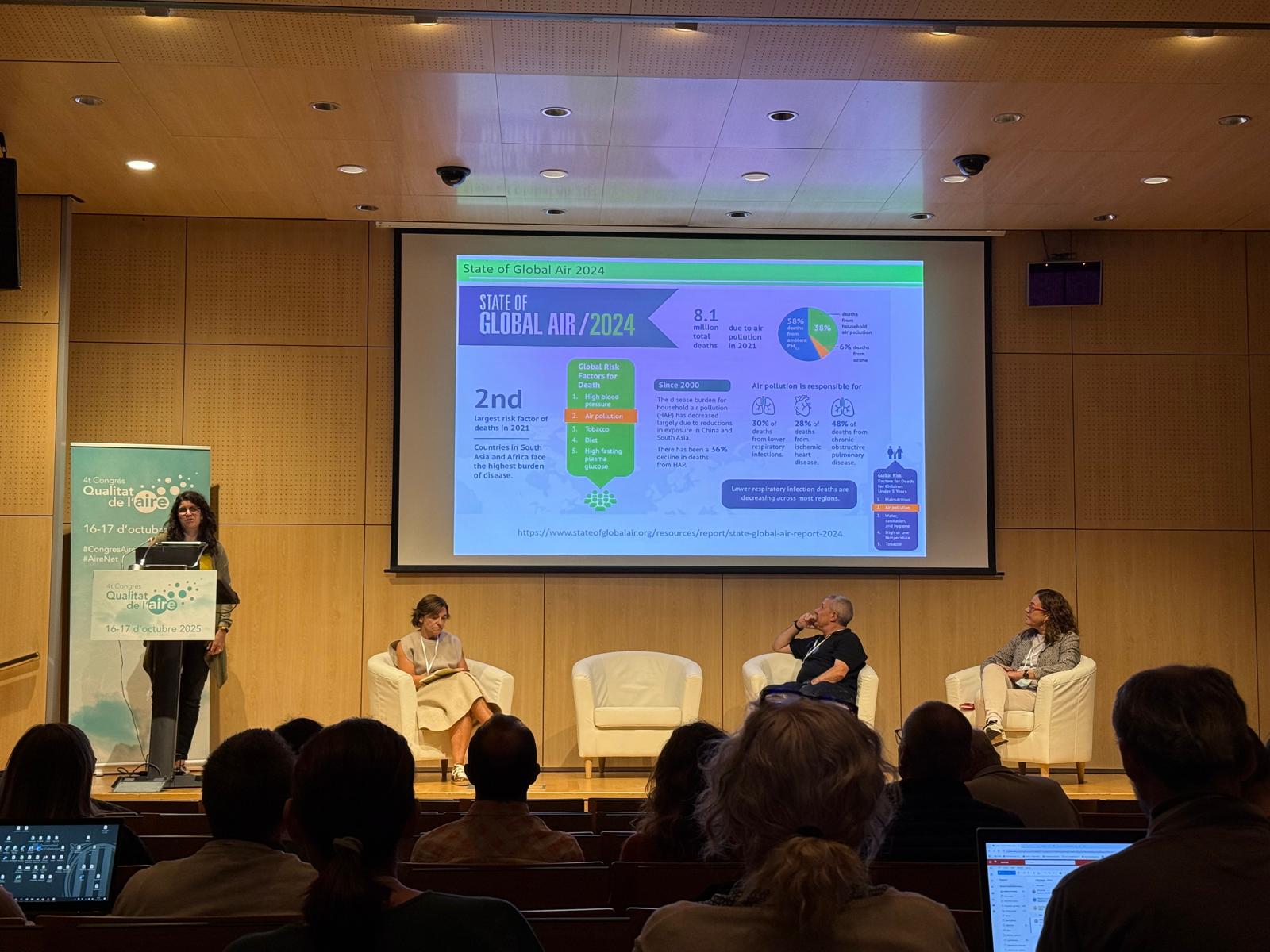
On October 16 and 17, 2025, the 4th Air Quality Congress of Sabadell took place. This meeting has become a reference space that brings together very diverse professional profiles linked to air quality: technicians from city councils, provincial councils and the Generalitat, research and outreach personnel, epidemiologists, representatives of citizen associations and health professionals, among others.

During the congress, the Air Quality Plan, horizon 2027 of the Generalitat, was presented, as well as the challenges and proposals to address the new European Air Quality Directive (which establishes much stricter limits for pollutants) and other issues related to the management of air pollution and its effects on health.

Within the framework of a specific panel on the impact of air quality on neurodevelopment and mental health, two researchers from the BiSC team, Laura Gómez and Ioar Rivas, presented the published results on the associations […]

2025-11-05T11:42:05+00:0005/11/2025|Outstanding, Results|

BiSC: the first study to analyze the association between air pollution and fetal brain development during pregnancy


BiSC: the first study to analyze the association between air pollution and fetal brain development during pregnancy


The study led by BiSC and published in The Lancet Planetary Health, analyzed data collected between 2018 and 2021 from 754 pairs of mothers and fetuses participating in the project. As you know, BiSC aims to understand the relationship between air pollution in child health and brain development and is considered one of the most comprehensive conducted in this field.

During the third trimester of pregnancy, participants underwent transvaginal neurosonography, a specialized ultrasound that allows the analysis of fetal brain shape and structures. Exposure to nitrogen dioxide (NO), particulate matter (PM2.5), and black carbon was estimated with hybrid models that combine data from real measurements with advanced statistical methods. The research considered three “microenvironments”: the participants’ homes, workplaces, and commuting routes. Data on activity patterns were collected via a geolocation app installed on the participants’ mobile phones.

The research team observed that […]

2025-09-25T10:29:05+00:0019/06/2025|Results|

The placenta as an early window to understanding brain development


The placenta as an early window to understanding brain development

BiSC researcher Dr. Marta Cosin Tomas has been awarded a prestigious 2024 NARSAD Young Investigator Grant from the Brain & Behavior Research Foundation. The foundation is an international non-profit organization focused on improving the understanding, prevention, and treatment of psychiatric and mental health disorders. The grant, worth $70,000 over two years (2025–2026), will support a pioneering project that studies how the placenta can provide clues about infant brain development, thanks to the participation of families from the BiSC (Barcelona Life Study Cohort) birth cohort.

Although we often think of the placenta as just a transit organ, responsible for transferring oxygen and nutrients from the mother to the fetus, science has discovered that it does much more. The placenta also produces hormones, neurotransmitters and growth factors that regulate brain development, and protects it from environmental stress. For this reason, it is often referred […]

2025-05-12T10:49:00+00:0007/04/2025|Results, Science|

What impact does passive smoking have during childhood?


What impact does passive smoking have during childhood?


Last month, national media reported on a study led by BiSC researchers Marta Cosín and Mariona Bustamante, in collaboration with the Barcelona Institute for Global Health (ISGlobal). The study, published in Environment International, stresses the need to reduce children’s exposure to passive smoking, since exposure to tobacco smoke during childhood can cause changes in DNA methylation, a process that affects gene regulation and could increase the risk of developing diseases in adulthood.

The study included data from 2,695 children between 7 and 10 years old from eight European countries. The scientists analyzed the level of methylation at specific sites in DNA in blood samples from the participants and associated it with the number of smokers in the home (one, two or more). The findings revealed alterations in eleven regions of DNA, six of which are associated with diseases such as asthma and cancer.

According to […]

2025-03-25T09:44:02+00:0010/03/2025|Results|

ISEE Young 2024 Best abstract award!


ISEE Young 2024 Best abstract award!


Yu Zhao, a predoctoral researcher and member of the BiSC team, attended the ISEE Young Conference 2024 and took the chance to present some results that are part of the FRONTIER study. She won the best abstract award in her category. Congratulations, Yu!

The ISEE-Young Conference is one of the most important international societies in our field of research. The abstract that Yu presented was about the role of placental function in the relationship between exposure to traffic-related air pollution during prenatal stages and impaired fetal growth. Yu Zhao, Toni Galmes, Payam Dadvand and the rest of the team analysed the data collected during the week 32 of gestation from 916 BiSC mothers!

After exploring placental function, they saw that the role of umbilical artery resistance might be important. High umbilical artery resistance might be related to less oxygen and nutrients transfer from mother to fetus. […]

2024-07-26T09:36:19+00:0003/07/2024|Results|

BiSC presents placenta genomics results at the European Congress of Human Genetics

BiSC presents placenta genomics results at the European Congress of Human Genetics

This week there was the European Congress of the Human Genetics Society in Berlin where the most relevant advances of the year were presented, both in the diagnosis of minority diseases (diseases caused by one or a few mutations) and in the identification of genetic risk variants for common diseases (diseases caused by multiple genetic variants and environmental factors).

BiSC participated by presenting the results of the identification of genetic variants associated with different molecular profiles of the placenta. On the one hand, we presented a poster on the genetic variants, both of the mother and the fetus, associated with the levels of microRNAs, small RNAs that have regulatory functions and that are known to be dysregulated in diseases such as pre-eclampsia.

On the other hand, as part of a study by the Pregnancy and Childhood Epigenetics (PACE) consortium led by […]

2024-06-26T07:58:51+00:0010/06/2024|Results|

WE ALREADY HAVE THE NEUROSONOGRAPHY DATA OF BiSC!

WE ALREADY HAVE THE NEUROSONOGRAPHY DATA OF BiSC!

As you know, one of the aims of the BiSC project is to investigate the effects of early exposure to various environmental factors on fetal neurodevelopment. During the follow-up of the project volunteers, a complete ultrasound was performed to collect parameters of the fetal brain anatomy at the 3rd trimester visit at each of the collaborating hospitals: Hospital de Sant Pau i la Santa Creu, Hospital Clínic – The Maternity Hospital and Sant Joan de Déu Hospital. This test is performed in the third trimester (around week 32 of gestation) because this is the period when the primary brain structures are already formed and beginning to mature. In fact, in the third trimester most of the fetus’s organs are already practically formed, but the nervous system, due to its high level of functional complexity and despite having started its development in the third […]

2023-04-28T08:42:55+00:0018/04/2023|Results|

We already have the genetic data of the BiSC mothers!

We already have the genetic data of the BiSC mothers!

We already have the genetic data of the BiSC mothers. For each mother we genotyped approximately half a million genetic variants. These data, together with those of the baby that we will obtain in the coming months, will help us to investigate the genetic contribution of mothers and babies in the functioning of the placenta. Specifically, we will study:

1) How genetic variants in the mother and the fetus control the flow of blood between the uterus, the placenta and the fetus.
2) How the genetic variants of the mother and the fetus control the different molecular patterns of the placenta.

You can find more information about the project at “The BiSC project will obtain genetic data from mothers and their babies”. *

In order for the identification of variants that control placental function to be fruitful, it is necessary to analyze as many samples […]

2023-04-18T12:44:51+00:0031/03/2023|Results|

COVID19 and maternal and child mental health within BiSC (MOOD-COVID)

We completed the collection of data from the study of confinement, COVID19 and maternal and child mental health within BiSC (MOOD-COVID)

The MOOD-COVID study studies the effects of COVID19 confinement and pandemic on maternal and child health within the BiSC population and is funded by the AXA Research Fund.

To obtain the data, during the confinement of March to June 2020, 5 successive surveys were conducted on the participants of the BiSC study. One year later, in June 2021, the final campaign was conducted with the submission of a final survey to study changes in mental health.

Participation during confinement was quite high. In the June 2021 […]

2021-07-20T16:31:33+00:0012/07/2021|Results|
Go to Top