NEW SUB-STUDY OF QUALITATIVE METHODOLOGIES


NEW SUB-STUDY OF QUALITATIVE METHODOLOGIES


You, the BiSC volunteers, have been collaborating with the project since you were pregnant. Since then we have collected a multitude of samples, both from you and your children, in addition to the information you have also been providing us with the online questionnaires and the face-to-face visits you have made with our neuropsychologists. The compilation of all this information is essential to be able to study the neurodevelopment of children, how the pollutants that surround us affect their correct growth.

In this sub-study it is intended to expand the observer’s gaze towards these data. The data collected through questionnaires allows us to obtain a multitude of information on the socio-economic contexts of our volunteers, in addition to other topics related to mental health and lifestyles. However, this type of data collection does not aim to obtain information that […]


2024-02-06T09:47:43+00:0022/01/2024|Evolution of the project, Participants|

How is the BiSC data processed?

How is the BiSC data processed?

As you probably know, a fundamental part of BiSC involves the collection, organization and structuring of data, along with the analysis and results that can be obtained. The Data Management team is responsible for ensuring that this data is coherently structured and for detecting possible problems at any stage of the process, whether in questionnaires or tests carried out during data collection.

Typically, to determine what we are working with, those responsible for the tests or samples inform us of the data they need us to process. Following an established protocol, we begin by cleaning the data for inconsistencies and organizing the variables for better structuring. From that point, the process can vary depending on the needs of the person responsible. This can range from simple tasks to complex statistical analyzes involving different types of data and specific samples.

It is important to remember that we always […]

2023-10-28T17:32:34+00:0025/10/2023|Evolution of the project|

We return with our batteries fully charged!

We return with our batteries fully charged!

Now that summer is over, and the entire team has been able to rest (And we hope all of you too!), we return to the office eager to continue with the project and gradually advance the research.

We are continually completing and finishing follow-ups and the fact is that… at the end of this month of September all BiSC children will be over 2 years old!!

As today, we have two follow-up stages in place in which we evaluate neurodevelopment and obtain very valuable information that we can return to you in the form of results reports explaining how your girls and boys are developing:

  • We do a remote follow-up at 28 months through questionnaires and neurodevelopment and language tests that you complete at home (online and on paper by postal mail). Then you return it to us, so we can evaluate it.
  • We also do […]
2023-10-01T20:18:19+00:0017/09/2023|Evolution of the project|

We are still in time to collect DNA samples for genetic studies. Let us explain how!

We are still in time to collect DNA samples for genetic studies. Let us explain how!

During childbirth, with the consent of the families, we collected cord blood and placenta samples for genetic studies. However, for some families we have not been able to make the collection for various reasons. Now, at the 4-year visit, we have the opportunity to collect saliva from the children to do genetic studies.

How will we do it?

Too easy! We will first ask the family for their consent. Then, in the presence of the parents, we will ask the infant to begin little by little to pour saliva into a special tube until completing the necessary limit indicated by the line. Finally, we will close the tube and store it. The collection is fast, non-invasive and innocuous. Once the samples are collected, they are sent to the laboratory for processing.

2023-07-19T06:51:48+00:0010/07/2023|Evolution of the project, Participants|

Let’s start analyzing exposure to noise pollution!


Let’s start analyzing exposure to noise pollution!

During weeks 12 and 32 of pregnancy, BiSC participants received a home visit from our fieldworkers. In these visits, among other tasks, the exposure to environmental pollution in the home of pregnant women was measured.

This exposure was measured with the help of different devices that recorded various parameters related to atmospheric pollution: air, and acoustic pollution, noise. And the latter is what we have started working on since last month.

In order to collect this type of information, a sound meter was installed in each house, which measured different variables related to noise on the main facade of the house. The devices take a reading every second and remain installed for an entire week. In addition, sometimes an extra sound level meter was placed on the front of the participant’s room. So we have a huge amount of data related to noise.


2023-06-14T07:24:51+00:0008/06/2023|Evolution of the project|

What tests are performed during the 4-year visit?

4 year old visit

This month of May we have started collecting data from the 4 years of BiSC children. We do this through a very complete face-to-face visit, in which we collect information about the health, habits and neuropsychological and anthropometric data of children, as well as information on the health status of BiSC mothers and fathers.

In this post we want to share with you a brief explanation of the tests that your sons and daughters will carry out for an hour while they are visiting, with a psychologist from the BiSC team.

These tests are:

  • The Kiddies Continuous Performance Test (K-CPT-2): A computerized test that evaluates the attentional capacities of the child. This is a task in which the child must detect objects that appear and disappear on the screen. They are everyday objects, such as a boat, a ball, a car, scissors… and react to them or let them […]
2023-05-29T07:37:32+00:0022/05/2023|Evolution of the project|

This May we finish the 18-month follow-up!


This May we finish the 18-month follow-up!

From the BiSC project team, we announce that the 18-month follow-up ends this May! This means that all BiSC boys and girls have already completed their first year and a half of life, after more than 2 and a half years since the first visit at that age.

The “star” test of this visit was the Bayley scale, which the BiSC families did with our psychologist, Muriel. In this test we were able to evaluate the cognitive and motor development, as well as the language development (receptive and expressive) of BiSC children. We know that the visit with Muriel was very enjoyable and that the families left very happy. In total we were able to visit 758 participants out of the 1029 boys and girls participating in the cohort. But aside from the Bayley scale, we have also carried out questionnaires that will help us […]

2023-05-15T10:38:13+00:0008/05/2023|Evolution of the project|

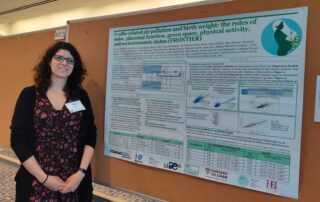
We present preliminary BiSC results at the Health Effects Institute conference

We present preliminary BiSC results at the Health Effects Institute conference

At BiSC we have been working hard for many months refining all the data that we are collecting in the different monitorings. The data collected in the prenatal period is already in a very advanced state and we can start with the first analyzes to assess how various environmental factors, lifestyles and other parameters affect the development of children.

On the one hand, we already have in a very advanced state the models that allow us to quantify the exposure to atmospheric pollutants of the participants during each week of their pregnancy. Based on the data we collected at prenatal visits, the knowledge of your address and thnks to complex statistical models (which take into account variations in time and space) we were able to assign to each of the participants the levels of air pollution for each week of pregnancy.

In […]

2023-05-16T10:44:34+00:0028/04/2023|Evolution of the project, Meetings|

How does a cohort work?

How does a cohort work?

Imagen


As you know, the BiSC project is an epidemiological cohort study. This means that the team follows up volunteers, during which we measure different variables, including exposure to various risk factors and their health outcomes.

In the case of BiSC, the cohort of volunteers is made up of you, the families. The risk factors we measure are numerous, but we focus primarily on urban exposures of mothers during pregnancy, and BiSC children during childhood (environmental pollution, exposure to green spaces and lifestyles). In terms of health outcomes, we collect biological samples to measure different compounds, and we also study child development and the onset of certain disorders, conditions and pathologies.

The aim of our work is to identify which factors may be related to certain outcomes in children’s health. Previous cohort studies have shown, for example, that high maternal blood levels of […]

2023-04-18T12:46:36+00:0023/03/2023|Evolution of the project|

Preparing the 4-years-visit

Preparing the 4-years-visit

As we already informed you in a previous piece of news, the BiSC Project received funding from La Marató de TV3 to be able to identify genetic, psychosocial and environmental risk factors in the appearance and evolution of neurobehavioral and emotional problems in the first four years of life. We will do all this through a new follow-up in the 4 years that is about to begin!

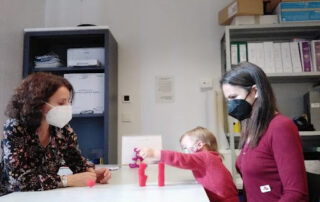
During the visit, the children will be with one of our neuropsychologists: Muriel, whom many of you already know her since she has been at the 18-month visit; and Lorena, the new psychologist who has joined the team since November. During the visit, a series of activities and games will be carried out with the children to evaluate their neurodevelopment on cognition, language, attention, motor skills, attention, etc. (similar to the 18-month visit but more complete since the kids are […]

2023-03-08T15:38:40+00:0021/02/2023|Evolution of the project|
Go to Top